💰Collector Market Today

Donor / parts · median
Not enough data
Working · median
Not enough data
Excellent condition · median
Not enough data

🌐Country Market Breakdown (Rough / Working / Boxed)

🇺🇸 USA (eBay US)—
Donor / parts:—
Working:—
Excellent:—
🇩🇪 Germany (eBay DE)—
Donor / parts:—
Working:—
Excellent:—
🇫🇷 France (eBay FR)—
Donor / parts:—
Working:—
Excellent:—
🇯🇵 Japan (Mercari/Yahoo)—
Donor / parts:—
Working:—
Excellent:—
🇬🇧 UK (eBay UK)—
Donor / parts:—
Working:—
Excellent:—

Launch Economy

💡 For the same $350 in 1982 you could buy a used «Zhiguli» VAZ-2101 in decent condition, while the Sharp itself cost as much as two monthly salaries of a research institute engineer.

🏛️Character & Memories

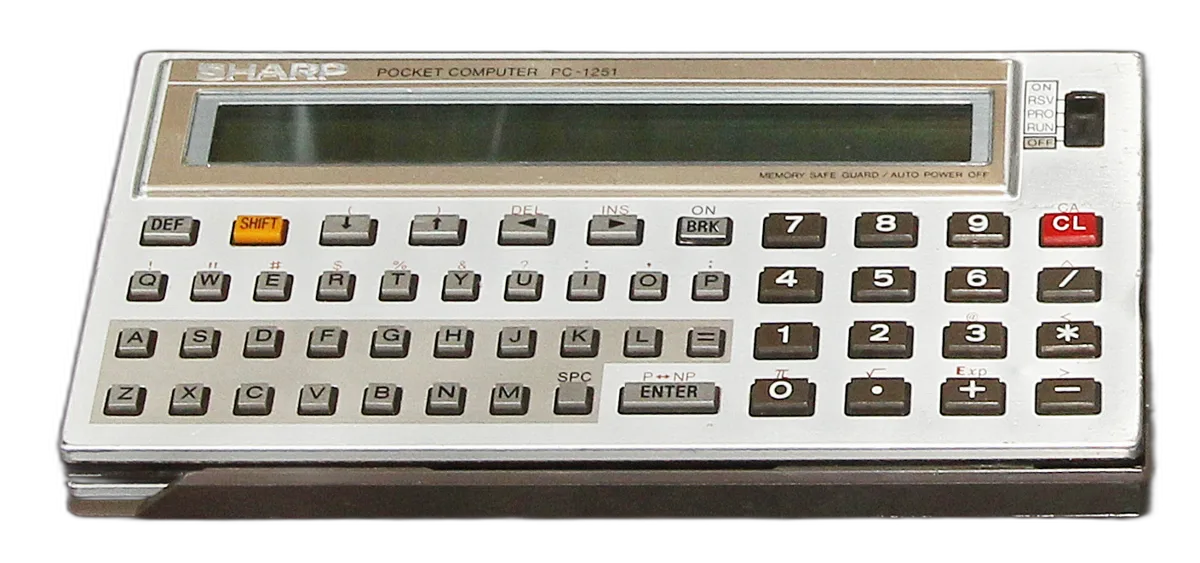
The Sharp PC-1251 is not «almost a computer» but an honest pocket BASIC computer of 1982 that survived on two AA cells and taught schoolchildren to write code long before affordable PCs appeared. Our unit is prized for its live keyboard and preserved acrylic — such units rarely reach the museum.

🖐️Tactile Feel & Materials

Body materials
Case in grey-beige ABS plastic with a fine pebble texture, keys are cast black plastic buttons with white silkscreen, and the metal screen sits under a clear acrylic window.
Mechanics sound (ASMR)
The keys on rubber semi-conductive pads travel short and muffled, with a light click at the end; the battery compartment cover locks with a juicy «clack», and the device itself springs slightly in your hand when pressed.
Backlight color
No backlight — a monochrome LCD without a lamp, readable only in external light; in the dark you had to catch the glow of a streetlamp or hold it under a desk lamp.

⚙️Hardware Anatomy

Battery
2x AA (LR6/HR6), плюс внутренний литиевый элемент CR-подобного типоразмера для питания памяти при смене батарей (держится годами, при посадке теряются программы)
Charging port
No charging port of its own — powered only by AA cells; for data exchange there was a proprietary 11-pin connector on the end for the official Sharp CE-125/CE-126P cable dock
Memory card
No slot (built-in memory only: 4 KB ROM for BASIC and ~2.2 KB RAM for programs and data)

🔧Factory Quirks & Repair

The main ailment is oxidation of the battery compartment contacts and electrolyte leakage from two AA cells, after which the traces by the keyboard rubber get eaten right through; the second is the fragile frame of the acrylic window, which cracks when pressed with a finger; the third is degradation of the conductive rubber under the keys, which makes individual rows of digits «drift». The fixes were cleaning with alcohol, placing foil under the rubber, and resoldering lifted pads.

🎮Preinstalled Games

Нет встроенных игр (только BASIC)
There were no factory games — the user typed in a program from a magazine or book listing and saved it to RAM; the most popular homemade ones were «guess the number» and a simple «lunar lander» in a couple dozen lines

📟Secret Service Codes

NEW 0The BASIC command to clear RAM and start a new program — the «magic button» for every owner
PEEK/POKEWorking with memory directly: PEEK reads a byte, POKE writes one — through them people reset a frozen machine and turned mode indicators on and off
CTRL+RESET (скрепка)Hardware reset via a recessed button on the case; resets the program but leaves the built-in BASIC untouched

📚Manuals & Schematics Archive

Original user guides and service circuit diagrams

User Manual1 pages
Original Sharp PC-1251 manual

⚔️Rival Duel

What is more honest for 1982 — the Japanese Sharp with real BASIC on 2.2 KB, or the Casio PB-100 with its more convenient display and the ability to program in a «calculator» language?

Sharp PC-1251

55%
vs

Casio FX-702P / PB-100

45%
📰

Community, Feed & Shelf

Live owner stories, video reviews and exhibits on Retro.mobi shelves