
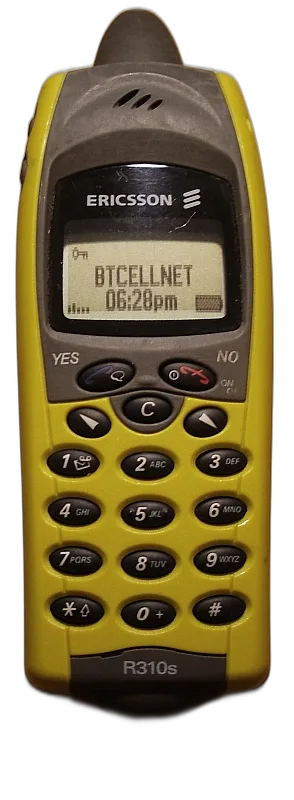
Ericsson R310s: the "Shark Fin", beer and NASA technology
Released in 2000, the Ericsson R310s became a legend among fishermen, hunters and extreme-sports enthusiasts. Its calling card was a flat, wide and flexible antenna, which instantly earned the phone the nickname "Shark Fin". A popular tall tale claimed you could open beer bottles with that antenna — and many people actually did (though the plastic base did eventually crack after a hundred or so of these tricks).
Swedish engineers set out to create a phone that could survive being submerged in water, covered in mud and dropped on rocks. The internals were potted in a special compound, and the two halves of the body were clamped together with powerful screws through a thick rubber gasket. But the designers faced a non-trivial physical problem: how do you make the device watertight while still getting the speaker and microphone to sound? After all, sound needs air.
The solution came from the gear of astronauts and mountaineers. Ericsson was the first in the industry to use Gore-Tex membranes in a mobile phone. These ultra-thin Teflon films, bonded from the inside over the speaker and microphone openings, had micropores. The pores were large enough to let sound waves (air molecules) through, but too small for a drop of water to seep through thanks to its surface tension. Thanks to this, the "Shark Fin" could ring even when smeared in liquid mud — you just had to rinse it off in a river.
💬 Discussion and reviews (0)
Join the museum club to take part in discussions and earn Bytes:
Sign In to Account